A comprehensive eye examination looks at more than whether you need glasses. Your optometrist asks about your vision and health, measures how clearly you see, checks the prescription you may need, and assesses your eye health. The exact tests vary according to your age, symptoms, history, and the optometrist’s professional judgement.
This guide explains the usual process at Pierre van Ryneveld Optometrist and where it may differ from one person to another.
What does “comprehensive” mean in an eye examination?
A quick vision screening answers a limited question, such as whether you can read letters of a certain size. A comprehensive eye examination brings several pieces of information together: your symptoms and history, clarity of vision, possible prescription, how your eyes function, and signs relating to eye health.
That distinction matters because seeing the smallest line on a chart does not, by itself, describe every aspect of vision or eye health. The American Optometric Association’s overview of comprehensive eye examinations lists patient history, visual acuity, refractive assessment, eye-function tests, and eye-health evaluation as possible components. It also notes that the tests selected depend on the patient’s signs, symptoms, and the optometrist’s judgment.
There is no single test sequence for every patient. Age, symptoms, and health history may change the emphasis or prompt additional assessment.
What happens at the beginning of the appointment?
Your optometrist first needs context. Expect questions about:
- What have you noticed, and when it started
- Your current glasses or contact lenses
- Previous eye problems or surgery
- Medicines and relevant general-health conditions
- Eye conditions in your family
- The visual demands of work, study, driving, and hobbies
Bring your current glasses and any contact-lens information you have. A list of medicines and relevant medical history can also help. If you intend to use medical aid, bring the details needed for a benefit enquiry. At Pierre van Ryneveld Optometrist, the practice can contact your medical aid to confirm available benefits and will discuss a quotation before it is submitted.
This conversation is not a formality. It helps the optometrist decide which examinations are appropriate and how to interpret the results.
How is your sight measured?
Visual-acuity testing
Visual acuity describes how clearly each eye sees at a set distance. You will usually read letters or symbols on a chart, one eye at a time. Near vision may also be checked where relevant. This identifies the level of detail you can see under the test conditions; it is not a complete eye-health assessment.
Estimating and refining a prescription
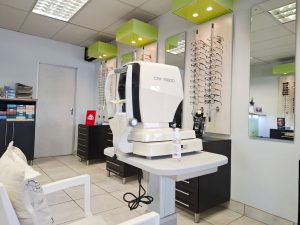
Autorefraction may be used to obtain an initial objective estimate of the eye’s focusing power. It gives the optometrist a useful starting point, but the machine result is not automatically your final prescription.
The prescription is refined using other findings and your responses to lens choices. You may be asked which of two options looks clearer. “They look the same” is useful when that is genuinely what you see.
The optometrist will explain whether a new or changed prescription is recommended. An eye examination does not automatically mean that you must buy new spectacles.
How are eye function and eye health assessed?
Depending on your age, history, symptoms, and results so far, the optometrist may assess aspects such as pupil responses, eye movements, focusing, or how the eyes work together. These checks help build a broader picture of visual function.
Eye-health assessment may include looking at the outside and inside structures of the eyes. At Pierre van Ryneveld Optometrist, an internal-eye assessment with a PanOptic instrument forms part of the standard process. This is an examination of structures inside the eye; it should not be confused with a digital scan.
Intraocular pressure, commonly called eye pressure, is measured as appropriate. This measurement contributes useful information, but it cannot by itself confirm or exclude glaucoma. The result needs to be considered with the rest of the examination.
Fundus photographs may be taken when clinically indicated. These are photographs of the back of the eye and can provide a record for assessment or comparison. They are not required in exactly the same circumstances for every person.
If a finding needs an assessment that the practice cannot perform, the patient is referred to an appropriate healthcare professional. Screening and observation are not the same as making a definitive diagnosis.
How long does a comprehensive eye examination take?
A typical eye examination at Pierre van Ryneveld Optometrist takes approximately 30 minutes. The time can vary because the optometrist may need to investigate a symptom, repeat a measurement, or perform an additional test.
Choosing frames, discussing lens options, taking dispensing measurements, and completing a quotation take extra time. If you need to return to work or collect a child, tell the practice when booking so you can plan realistically.
Is an eye examination painful?
Most routine tests are non-invasive and should not be painful, although bright lights can be temporarily uncomfortable. Tell the optometrist if you feel anxious or uncomfortable.
Do not wait for a routine appointment if you have sudden vision loss, a new curtain or shadow in your vision, severe eye pain, an eye injury, chemical exposure, or new neurological symptoms. Seek prompt assessment from an appropriate emergency service or healthcare professional. This is not a complete emergency-symptom list.
What happens after the tests?
The optometrist brings the results together and explains what they mean for you. Useful questions include:
- Has my prescription changed?
- Do I need glasses for all tasks or only certain activities?
- Did you find anything that should be monitored or referred?
- When should I have my next examination?
- Which lens options are relevant to my actual needs?
If glasses are recommended, dispensing is a separate conversation. Frame fit, prescription, work demands, lifestyle, and budget all influence the choice. At the practice, the quotation is discussed in detail before medical-aid submission. Ask for an explanation of any item you do not understand.
How should you prepare for your appointment?
You do not need to study for an eye examination. A little preparation can make the discussion more useful:
- Bring the glasses you currently use, even if they no longer work well.
- Note your symptoms, when they occur, and what makes them better or worse.
- Bring relevant medicine, medical-aid and eye-health information.
- Think about the tasks that matter most, such as driving, screens, reading or schoolwork.
- Allow extra time if you may choose frames or discuss lenses afterwards.
For a child’s appointment, bring any feedback from a teacher and describe the visual behaviour you have noticed without coaching the child on what to say.
Request an eye examination in Pierre van Ryneveld
Pierre van Ryneveld Optometrist is an independent, family-focused practice serving Pierre van Ryneveld, Centurion, and the surrounding areas. A typical examination takes about 30 minutes, with dispensing time added if needed.
To request an eye examination, call 012 662 0188, WhatsApp 061 592 8356, or visit Shop 9, Ryneveld Lifestyle Centre, corner of Pieter Botha Street and Van Ryneveld Avenue, Pierre van Ryneveld.
Frequently asked questions
Do I need an eye examination if I can see clearly?
Clear distance vision is only one part of the picture. An examination may also consider near vision, visual function, symptoms, and eye health. Your appropriate examination interval depends on your age, history, risk factors, and an optometrist’s advice.
Will an autorefractor give my final prescription?
Not usually. Autorefraction provides an objective starting estimate. The optometrist interprets it with your responses, visual needs, and other findings before recommending a prescription.
Does a normal eye-pressure reading rule out glaucoma?
No. Eye pressure is one part of a broader assessment. A single reading cannot, on its own, confirm or exclude glaucoma.
Will I have a fundus photograph at every visit?
Not necessarily. At Pierre van Ryneveld Optometrist, fundus photographs may be taken when clinically indicated. The optometrist decides what is appropriate for the individual examination.
Can the practice check my medical-aid benefits?
Yes. The practice can contact your medical aid to confirm available benefits. The quotation is discussed with you before submission, but the scheme remains responsible for confirming and paying benefits under your plan.
Does an eye examination mean I must buy glasses?
No. The examination determines your visual and eye-health findings. If a prescription or new glasses are recommended, the reasons and relevant options can be discussed separately.
This article provides general eye-health information and does not replace an eye examination or individual medical advice. If you are concerned about your vision or eye health, consult an appropriately registered healthcare professional.
